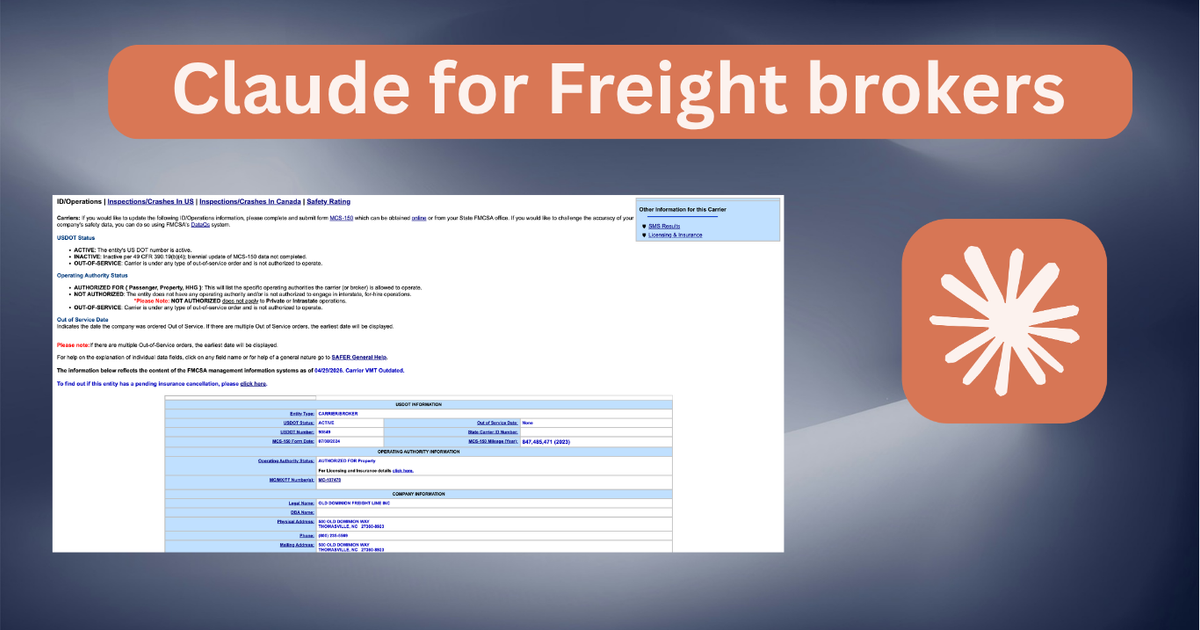
The math nobody likes
A typical carrier check before booking takes 10–20 minutes. Open SAFER, plug in the USDOT, eyeball the safety profile. Open L&I, check insurance is active and the limits match the load. Open CSA SMS for BASIC scores. Open Carrier411 or Highway for fraud flags. Cross-reference the legal name on the rate confirmation against what's actually on file. Flag the new authorities. Check OOS history.
For a small-to-mid freight broker, that's 50–200 vettings a week. At 15 minutes each, one dispatcher loses 12–50 hours weekly to clicking through public registries. That's a quarter of a full-time role doing nothing but copy-paste.
The work matters — per Highway's 2024 fraud report, freight fraud rose 27% year-over-year, with identity theft and double brokering leading the attack vectors and bad actors buying old MC numbers in bulk to use as fronts. But the process of fighting it is exactly the kind of mechanical task AI handles better than humans.
This post shows how to cut that 15 minutes to 30 seconds for the FMCSA portion of vetting, using a free tool that connects to Claude (or ChatGPT) in three minutes.
Who this is for
Dispatchers, operations managers, and compliance staff at US freight brokers — the people running or supervising carrier onboarding. If a team is already using Carrier411, Highway, or MyCarrierPackets and still running manual SAFER lookups on top, this is for them.
For brokerages outside US interstate freight, this specific tool won't help, but the underlying approach — wrapping public registries in chat-accessible tools — applies to any compliance source. More on that at the end.
What carrier vetting actually contains
A complete pre-booking check covers six layers:
- Identity. Legal name, DBA, address. Does the rate confirmation match what's on file?
- Authority. Active operating status, MC/USDOT match, authority age. New authorities (under 6 months) carry elevated risk.
- Safety record. Safety rating, recent crashes broken down by severity, inspection counts, OOS rates compared to the national average.
- Insurance. Liability and cargo coverage, policy currently on file, limits adequate for the load.
- Behavioral data. CSA SMS scores across BASIC categories.
- Reputation. Third-party blacklists, fraud alerts, broker community feedback.
Layers 1–3 live in FMCSA SAFER. Layer 4 lives in FMCSA L&I. Layer 5 lives in FMCSA CSA SMS. Layer 6 lives in commercial services with paid APIs.
The free MCP server below covers layers 1–3. Layers 4–6 are addressable by the same approach but need separate work.
The bottleneck: four sites, no integration
None of these sources talk to each other. SAFER doesn't show insurance. L&I doesn't show crashes. CSA SMS sits in its own portal. There's no consolidated view.
RPA scripts can paper over the clicks, but they break every time a portal updates, and they don't reason about edge cases. Is "JT EXPRESS INC" on the rate confirmation the same as "J.T. EXPRESS LLC" in SAFER? RPA can't tell. A reasoning model can.
This is the gap AI agents now fill — not because the AI is smarter than the dispatcher, but because it never gets bored, never misses a tab, and consolidates four sources into one answer in seconds.
What MCP is
MCP (Model Context Protocol) is the standard that lets AI agents reach into external systems: pull data, run lookups, take actions. For an end user it works like this — connect a server once, then ask the AI to do anything that server can do, in plain language.
For carrier vetting, an MCP server wrapping FMCSA means the AI can query the agency directly. No manual copy-paste. No "open this URL, scroll to this field." Just: "vet USDOT 1234567 — here's what the carrier represented" → answer in seconds.
The free FMCSA MCP
ProcAI published an open MCP server for FMCSA SAFER, available at:
https://fmcsa-mcp.procai.agency/
Connection takes about three minutes inside Claude:
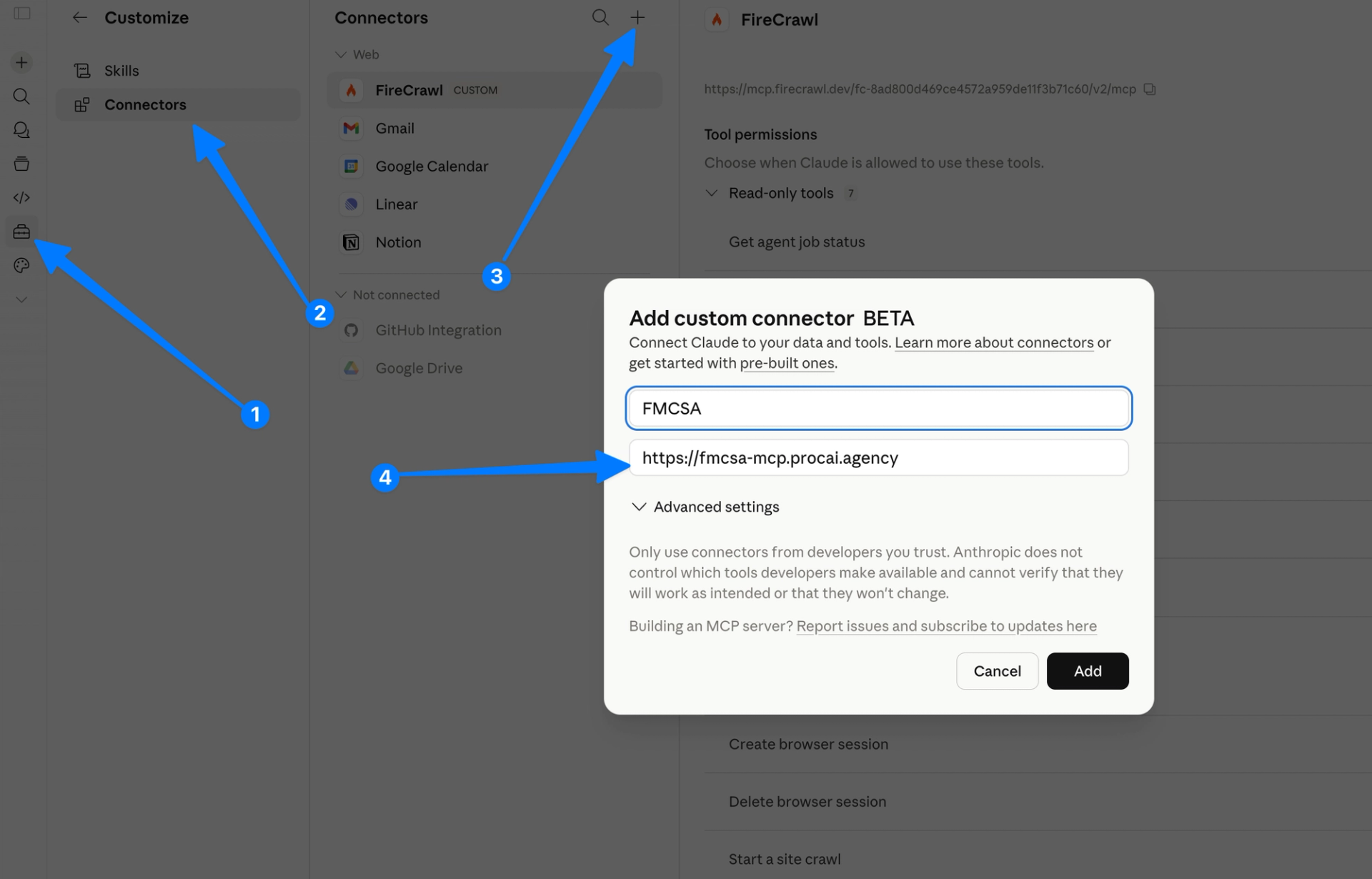
After connecting, the FMCSA tool appears in Claude's available connectors.
From here, the agent can be asked things like:
- "Vet USDOT 1234567 — the carrier said they're 'XYZ Logistics LLC' based in Dallas. Does that match?"
- "Pull the safety profile for these 10 USDOTs and flag any with fatal crashes in the last 24 months."
- "Compare USDOT 111 and USDOT 222. Which has better OOS rates?"
A typical response looks like this:
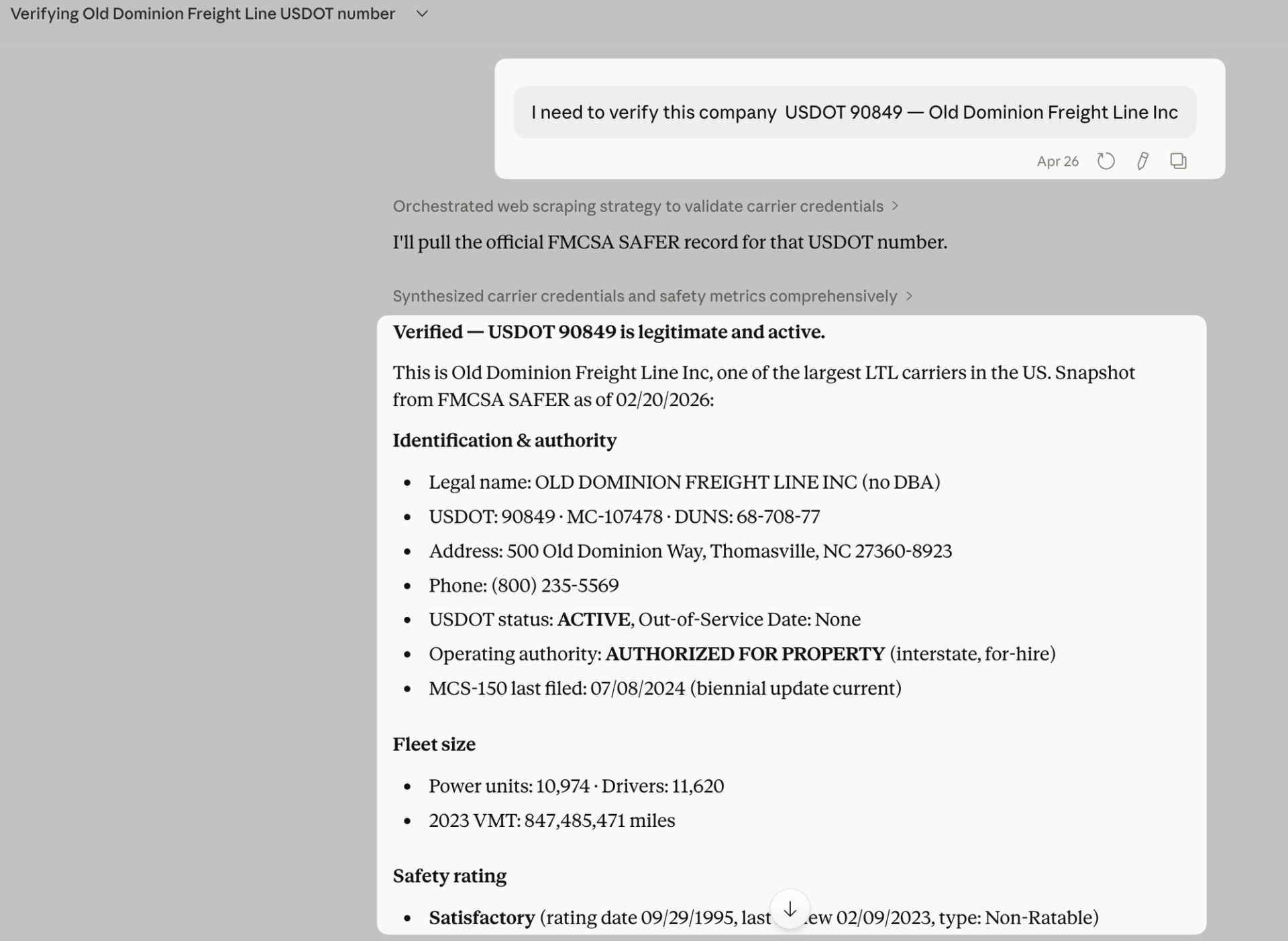
What comes back, per query:
- Legal name and DBA on file at FMCSA
- Operating status (active, out of service, not authorized)
- Authority granted date
- Power units and drivers
- Crashes in the last 24 months, broken down by fatal, injury, and tow-away
- Inspection counts and OOS rates compared to the national average
- Safety rating where available
- Name and address match against whatever was provided in the prompt
Ten USDOTs at once with a request for a comparison table comes back in under a minute.
Try it, then decide
The FMCSA MCP is free, open, and ready. Connect it, run a few real vettings, see whether it actually shaves the time it claims to.
For teams that need more — coverage of L&I, CSA, a commercial blacklist, or a custom integration with a TMS or internal compliance system — ProcAI builds those under contract. First call is a free diagnostic: review the source, estimate realistic scope and timeline, no obligation.
FAQ
Will this work with ChatGPT instead of Claude?
Yes. ChatGPT Desktop supports MCP via Custom Connectors. The connection menu is different, but the server URL is the same. A separate walkthrough for ChatGPT setup is coming.
What if the carrier isn't in FMCSA at all?
A carrier hauling interstate freight in the US must be in FMCSA. The MCP returns "not found" when the USDOT doesn't exist or the carrier was deactivated. That itself is a red flag worth catching.
Is the data secure?
Queries hit public FMCSA endpoints. Nothing is stored on the MCP side. The conversation itself lives in Claude (or ChatGPT) under their respective data policies — worth reviewing those if handling sensitive customer information.
Can it auto-flag carriers based on our criteria?
Yes. Tell the agent the rules — "flag any carrier with a safety rating below Satisfactory, any fatal crashes in 24 months, or authority less than 6 months old" — and it applies them across every vetting in that conversation.
Does this replace Carrier411, Highway, or MyCarrierPackets?
No. Those services carry fraud intelligence and broker feedback that aren't in any government registry. The MCP replaces the manual SAFER step that runs in parallel with those services — one consolidated answer instead of three open tabs.